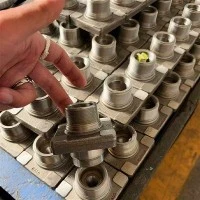
Advantages of Internal Machine Components
Sep 16, 2026
The core advantages of internal machine components lie in three key areas: precision matching, operational adaptability, and long-term cost reduction. Together, these ensure the stable and efficient operation of the entire piece of equipment from the ground up.
High-Precision Matching
These components strictly adhere to the design standards of the original equipment, with dimensional tolerances controlled within ±0.005 mm.
Interfaces align perfectly with the equipment's original assembly benchmarks, eliminating the need for forced fitting or additional adjustments-thereby preventing premature deformation caused by assembly stress.
Micron-level precision control significantly reduces vibration and noise during operation, minimizing common issues such as abnormal sounds and positioning errors.
Operational Adaptability and Durability
Materials can be customized for specific operating environments; for instance, Hastelloy C276 is used for highly corrosive settings, while molybdenum-containing heat-resistant alloys are employed for high-temperature conditions.
Critical load-bearing surfaces are strengthened through processes like nitriding or laser cladding, achieving a surface hardness of over HV950-extending service life to more than twice that of generic, off-the-shelf parts.
A comprehensive quality control system covers the entire production process; every batch undergoes inspection via coordinate measuring machines (CMM), ensuring zero-failure performance over 2,000 hours of continuous operation.
Long-Term Cost-Effectiveness
Precise dimensional and material matching reduces the overall equipment failure rate by more than 30%, drastically cutting down on unplanned downtime.
Designed in sync with the equipment, these components wear at a rate consistent with the original design specifications, preventing accelerated wear on other parts of the machine caused by component incompatibility.
Reliable service life reduces the labor and material costs associated with frequent replacements, offering far greater long-term value compared to low-quality, generic alternatives.