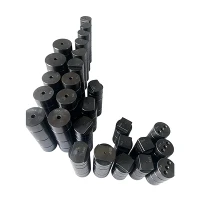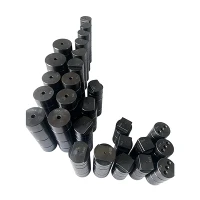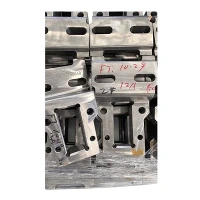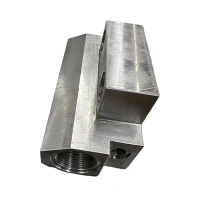
Types of External Locking Devices for Railway Turnouts
Sep 02, 2026
In China, the primary standard types of external locking devices for railway turnouts are the "hook-type" and the "dovetail-type," with various sub-types derived from these to suit different operational scenarios.
Hook-Type External Locking Devices
This is the most widely used type on China's high-speed and upgraded main-line railways. It employs a vertical locking mechanism.
The locking force is transmitted directly to the stock rail via the locking bar and locking frame. Since the locking bar is subjected to minimal bending moment, the system offers exceptional locking rigidity.
Key components are forged from high-quality carbon structural steel and heat-treated, ensuring superior mechanical properties and a very low risk of fracture.
This design is highly resilient against common turnout defects-such as arching, overturning, or "hanging" (lack of ballast support) of the switch rail-and exhibits a significantly lower rate of jamming compared to the dovetail-type design.
It can be configured for single-point, two-point, or multi-point (three-point) actuation and locking to accommodate long-switch turnouts, such as those with No. 18 or No. 42 geometry.
Common variants include the GW and GW-SH series (featuring a dual-slider mechanism) and the HRS series (utilizing roller-supported transmission); all comply with the industry standard TB/T 3534-2018.
Dovetail-Type External Locking Devices
This was the first type of external locking mechanism to be deployed on a large scale in China, entering service in 1991 on the Guangzhou–Shenzhen semi-high-speed railway. It utilizes a horizontal locking mechanism.
The core of the locking system consists of a dovetail-shaped groove-and-tenon interface. The overall design is compact, and it was once extensively used on turnouts for conventional (non-high-speed) lines.
The locking bar is subject to significant bending moments. Early versions, often made of cast material, were prone to fractures; furthermore, the design is less tolerant of variations in track gauge or deformations in the switch rail.
While largely phased out for new railway construction, this type remains in widespread use on older lines-specifically on secondary tracks within stations-as well as in locking mechanisms for movable-point frogs and wing rails.